In wildlife rehabilitation, our job is to change lives through healing wounds, raising babies, easing suffering, and sometimes by finding the best place for critters who are no longer able to thrive. While every animal we help impacts us in some way, there are those special few that touch our hearts and change us for the better. Here we highlight some of those critters that have left their mark on us and our work.
March, 2026 – Foster Feature: Rhea the Red Fox – Story and Photos by Kaley Egan
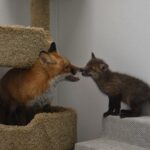 eding space and time to grow, the kit was stabilized and was doing well! At this young and impressionable age, it can be easy for fox kits to become habituated to humans and imprint on their caregivers if they do not have other foxes to interact with. As the days passed and they still had not received any other kits at all similar age, West Shore’s team became concerned. In the ultimate best interest of the young kit, they transferred her to our facility knowing that we had Rhea, a non-rele
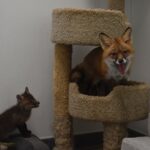 asable red fox able to act as a surrogate mother.
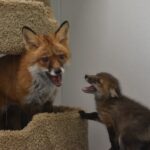 s at each other. No need to worry, this actually isn’t a sign of aggression! Foxes will do this as a friendly greeting, and often an invitation to play. We have been monitoring this new family very closely and have seen no signs of aggression, just a normal dynamic between mother and kit!
January, 2026 – From Dreaming to Believing – Story and Photos by Maya Berger
In the fall of 2023, I enrolled in an Ornithology course to fulfill an elective biology requirement to finish up my degree. Even though I had expected the course to be interesting, I soon discovered a love for all things bird. I began birding on my own and creating a life list of all the species I saw. During the class, we had to do presentations on an academic
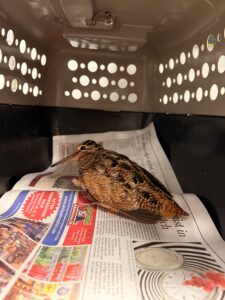
paper about birds. One student did hers on the American Woodcock, and from that moment on, I was obsessed. They were such a unique bird with their long beaks, dance-like movements, and distinguishing “meep” call.
I made it a personal goal to see one in real life. In March of 2025, I had the opportunity to attend a “woodcock watch”, which was hosted by landowners who had woodcock designated habitat on their property. At dusk, they took us out to the habitat, and we stood silently waiting for the woodcocks to appear. We began to hear the familiar “meep” of their call, and saw them flying overhead. It was such an incredible experience, but to me, it wasn’t satisfying enough.
In May I began working at Red Creek full time as a rehabilitation assistant. Most rehabbers have their dream species to work with, and for me, it was the woodcock. As an intern, I had left at the end of summer, so this was my first time experiencing the fall rehabilitation season. I knew Red Creek had gotten woodcocks in the past, typically arriving in the fall, so I had crossed my fingers and waited for the day I would come into work and be met with my favorite bird. As fall went on and no calls came in about a woodcock, I started to lose hope.
That was until the evening of November 19, when I got a text from my friend with a picture of an injured bird he had found in the parking lot of his job. I could not believe what I was seeing. He knew what my favorite bird was, so at first, I thought he was playing a prank on me. I dropped everything and drove to
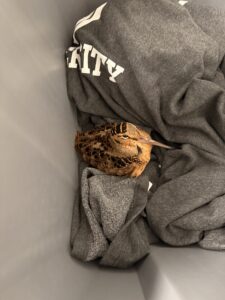
pick it up. I didn’t want to believe it until I saw it with my own eyes. That night will forever live in my memory because it was exactly what I had hoped for, a woodcock. Not only that, but instead of waiting for it to show up at the facility, I got to bring it there myself.
It was around 9 pm that evening when I arrived at the facility and gave it a quick initial exam since it was stressed from the ordeal. I found it had a pretty severe
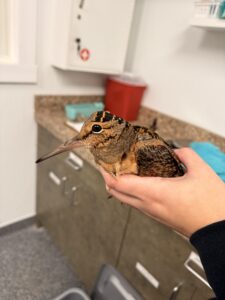
head injury as well as a small break on its beak. I set it up in a temporary enclosure for the night, hoping it would survive the night. The main difficulty with woodcocks in rehab facilities is getting them to eat. They are high stress birds, and they have a specific way of eating (probing soil for earthworms). Because of these complications, they tend to not have high recovery success rates.
After a day in a smaller enclosure to help the head injury heal, I created a more natural enclosure with leaves and a water dish. I was so excited, I drove to the closest bait shop and bought earthworms for it to eat. I specifically counted out how many worms I put in so we could determine if it ate or not. Coming into work the next day I was prepared to find all of the worms remaining and have to brainstorm a new plan, but to my surprise, it had eaten every single worm in the bin!
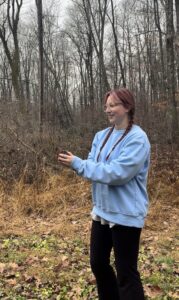
As its stay continued, it became clear that eating would not be an issue, which defied all odds. It continued to recover, showing great progress and healing from the head injury. The beak injury healed as well (and obviously did not affect its ability to eat), and a week after admission, we felt it was ready to fly free again. A few of us went along on the release and found a nice habitat for it. Tears filled my eyes as I held it in my hands and it flew away back into the wild to live a long, happy, worm-filled life. I was so honored to play such a large role in giving a second chance to my favorite bird. I could not have done it without the guidance of my incredible coworkers and I thank them for taking such good care of it on my days off.
—————————————————————————————————–
December, 2025 – A Coyote’s Bumpy Road to Recovery – Story and Photos by Kaley Egan
I have been one of Red Creek’s head wildlife rehabilitators for nearly four years now, and like many of our staff, I have been wanting to rescue animals since I was a young girl. I would play veterinarian with my many stuffed animals, bandaging their “broken” arms and legs with strips of old t-shirts and linens – once they had healed, the stuffed foxes and lions would resume romping around in my bedroom. Years later, I am working in the demanding and rewarding field of wildlife rehabilitation but it wasn’t until this summer when those same miraculous dreams I had as a child came to life.
At the very beginning of July 2024, we admitted a coyote pup that had been hit by a car and was found lying on the side of a busy road. Vehicle accidents can be traumatic for wildlife, resulting in severe injuries and unforeseen complications. Once this pup had some time to rest, we were quick to complete an in-depth exam and preform X-rays. Upon exam, there were no broken bones, but he would not stand up or use h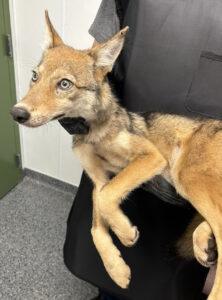 is back legs and his stomach was swollen, a sign of possible internal damage from the accident. We consulted with our veterinarian, and agreed to just let the young coyote rest and recover. One of my favorite animals to work with, I was thrilled to have a chance to work with him, yet realistically worried he would not make it through the night. Yet, he did.
I estimated that this young pup was about three months old, probably born in April of 2024. He was weaned from his mother, but not old enough to leave his family unit yet. After allowing him a few weeks of rest, we planned to move him into an outdoor enclosure with enough space to run around and exercise, ensuring that all of his bumps and bruises had healed well, and then return him to the area where his pack lives. Filled with excitement, we moved him to the enclosure with expectations to release him the following day. Unfortunately, despite our efforts to limit dangerous obstacles in the pen, this wi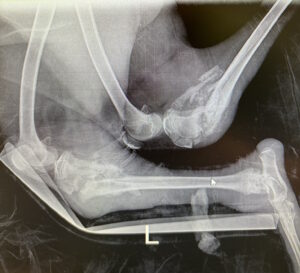 ld pup managed to trip and break both of his back legs overnight.
I was devastated – the very last thing a wildlife professional wants is for an animal to become injured in their care. Beyond this, I was not optimistic that this athletic, high-stress coyote would be able to recover from two broken legs. Once again, I consulted with our veterinarian and he assured me that we would be able to bandage the broken bones in-house and they should heal. So, we gave this pup our very best shot. Months of bandage changes, bedsores, medications, follow-up X-rays, and plenty of TLC resulted in something I truly was too afraid to hope for: a full recovery. To prevent a repeat of his injuries, we transitioned him very slowly into larger spaces as he healed.
For months of his recovery, the only way that I knew he was healing was through X-rays – he would rarely move for his daily cleaning and feeding indoors. While they can be fierce predators in the wild, this young coyote would cower away from his caretakers and only moved and ate at night when we were not around. This made his treatment safer and easier on our staff, but it did not provide any insight on how his legs were healing. Once he was healthy enough to transition to be housed in a small room in our clinic building, we installed a camera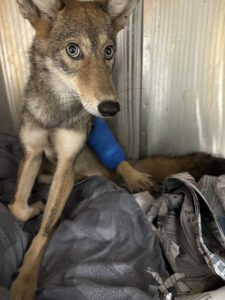 to hopefully catch a glimpse of him moving. This choice certainly paid off, with footage of not only the pup walking around, but also videos of him playing, chasing his tail, and standing up on two strong back legs to look out the window of his room. Thrilled with his progress, I knew that his last test with us was coming soon: returning to that same large outdoor enclosure. When moving him outside, I held my breath. I knew how far he had come, and I had watched him on the camera footage with a now strong healthy body, but I still feared another accident. However, my worries faded as I watched him bolt around the pen without even a limp.
Finally out of the woods and recovered, we were ready to make release plans once again. However, this was much more complicated th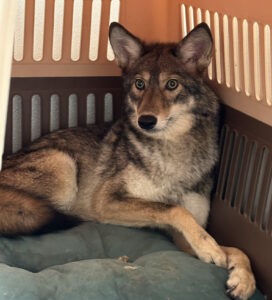 an before. Coyote pups typically remain within their family units until they are five to six months old, after which they will disperse and live on their own until they have their own family or join another. In November, he was over seven months old – he would not be accepted back into his pack. Not only this, but he came in at a vulnerable age at which he likely would not have hunted on his own very much, if at all. Despite there being less than normal food available in the winter, we did not want to hold onto this nearly adult coyote for an additional three to four months until spring. We found a perfect location with the help of Pennsylvania’s Department of Conservation and Natural Resources and the Pennsylvania Game Commission – food would be available for him all winter and there is a healthy coyote population in this area for him to thrive with.
On December 17th, I released this coyote back into the wild. I had my professional camera at the ready, hopeful to capture the 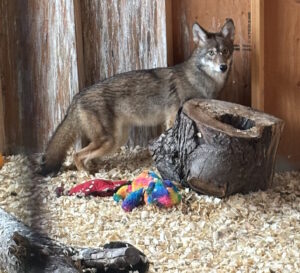 moment we had all been working towards for months. But, he shot out of his transport carrier like a bullet, sprinting and bounding across the large field faster than my camera could even capture. What I thought would be an easy and rewarding three-week recovery turned into an emotional rollercoaster that lasted five months and fifteen days. I wish that this pup’s recovery had gone more smoothly, but this journey and his story is exactly the reason why I do what I do. It reminds me how fiercely resilient wildlife can be, and I know that little girl bandaging stuffed animals would be proud of the both of us.